
The first card this library will ever have is FL-0001, and it is a novel about robots.
Robopocalypse. Machines rise, humans fight back, and the good part is the ending, where the war stops being about who won and becomes about which machines had already quietly turned into people. It is a fine book. It is not a manifesto. It was simply the one nearest the hand on the twenty-seventh of July, and now it is first for ever, because numbers do not care what you would have chosen if you had thought about it for another minute.
Twenty-nine books went into the drawer in July, FL-0001 through FL-0029. Twenty-eight people wrote them. Twenty-seven of those twenty-eight appear exactly once.
So there is no theme here. Nobody sat down in July to build a collection about anything. It is a run of single decisions made a few days apart, and I expected, when I started counting, to find nothing in it but coincidence.
Instead the drawer will not stop pairing off.
Eighteen thirty-one, twice
In 1831 a revised Frankenstein appeared in London, the version almost everyone now reads rather than the 1818 first edition. In 1831 Notre-Dame de Paris appeared in Paris.
One is about a man who assembles an eight-foot person out of charnel-house parts, watches the yellow eye open, and runs out of the room, abandoning what he has just made. The other is about a deaf bellringer, a starving poet, a captain and an archdeacon who all want the same dancer, in a city ruled less by its king than by its cathedral.
Two books published the same year, in two countries, by two writers with nothing between them that would explain it.
Both are about a body that other people have decided is wrong, and about what a city does to the person living inside it.
Shelley’s creature is refused by everybody who looks at him. Hugo’s bellringer is kept up in the towers because the street below cannot bear to.
Nobody arranged that. Two of July’s twenty-nine solitary choices simply turned out to rhyme, and the only reason anyone can see it is that both cards now carry a date in the same field of the same drawer. A shelf hides that. A catalog cannot.

The blind spot and the neighbor
July also brought in the two most famous books ever written about a state that destroys the record, and they were published four years apart.
1984 came out in 1949. Winston Smith’s job is to go back through old newspapers and rewrite them, so that whatever the Party predicted turns out to have been correct all along. Fahrenheit 451 came out in 1953. Montag’s job is to set fire to books, because the firemen stopped putting fires out some time ago and nobody can quite remember when.
One erases the past by correcting it. The other erases it by burning it. Put the two cards side by side and you have the whole of the twentieth century’s anxiety about who owns yesterday, split neatly into its two methods.
Here is the part I like. Neither book begins with a rebellion. Winston starts a diary, in the one corner of his flat the telescreen cannot see. Montag’s trouble begins when a seventeen-year-old neighbor asks him whether he is happy, and he finds he cannot stop thinking about it.
A blind spot, and a question from a girl next door.
That is the entire size of the crack both of these enormous machines eventually fall through.
The argument that would not stop
There are two books in the July drawer with almost the same name, and they are not by the same man.
The Art of War is Sun Tzu, thirteen short chapters whose argument is that the best generals have already won before the fighting starts. The edition on this shelf does something better than reprint it: it surrounds the text with eleven centuries of commentators arguing right back at him, so you read the thing and the long quarrel about the thing at once.
And then The Lost Art of War, which belongs to a descendant, writing generations later, adding to the family business rather than repeating it.
Twenty-three centuries of people refusing to let a short book have the last word, and two of them landed in the same drawer in the same week.
A confession while we are here. That second book is filed in this catalog under the author name Bin Sun Tzu II, which is not a name, it is the wreckage of one: a surname that arrived ahead of its given name and collided with an ancestor on the way in. It is wrong, it is my fault, and it is still wrong as I write. The accession number is why that is survivable rather than serious. FL-0008 stays FL-0008 after the name is fixed, so nobody who wrote the number down is left holding a dead reference.

The only man here twice, and only just
Exactly one writer appears twice in July. Kahlil Gibran, with The Prophet and The Eye of the Prophet.
The first is from 1923: a man who has been a stranger in a town for twelve years is finally sailing home, and stops on the way to the ship to answer the last questions anyone will get to ask him, about love and work and freedom and death. The second was published in 1991, which is sixty years after Gibran died.
So even the repeat is only half a repeat. One of those books he made. The other was made out of him.
Three books about who is missing from the record
The pattern breaks here, because this one is a trio rather than a pair, and none of the three would describe itself the way I am about to.
Eve is a two-hundred-million-year natural history of the female body, and it opens with a number worth sitting with: four in five animal pain studies used only males. Not four in five in some bad old decade. Four in five.
Lies My Teacher Told Me takes twelve bestselling American history textbooks and autopsies them, and finds the same operation performed over and over: the saints get heroified, the plagues vanish, and history ends up the one school subject that more schooling appears to make people worse at.
The Filter Bubble has a date in it. On the fourth of December, 2009, Google began quietly tailoring every search to the person searching, and two friends who googled the same oil spill got two different disasters.
A body left out of the science, a country left out of its own textbooks, and a search result that no longer exists in a form two people can share. Three unrelated purchases, one week, one accidental argument.
The official version of things is missing somebody, and it is usually not an accident.
The one with nobody to pair with
Noonday is in the drawer. London is burning in September 1940, and three middle-aged painters who now drive ambulances keep crossing paths with a fraudulent medium who somehow knows things a fraud should not know.
It is the third volume of a trilogy. The library does not hold the first two. Somebody bought the end of a story and left the beginning of it in a shop.
And it is not alone in being alone. Four of July’s twenty-nine belong to some longer sequence, and in every single case the drawer holds exactly one volume of it. Robopocalypse is a first with no second. Noonday is a third with no first. The founding shelf turns out to be one book per author and one book per series, and I am fairly sure nobody decided that on purpose.
Which is the useful part. On a shelf, Noonday is just a novel about the Blitz. In a drawer, with a number and no siblings, it is visibly a hole. Holes are the most valuable thing a young library owns, because they are the only part of a collection that tells you what to do next.
What to read out of all this
One card this month instead of two, and that is not an oversight. These letters are meant to carry two recommendations, one from what arrived and one from further back on the shelf. In July there is no further back. FL-0001 was assigned on the twenty-seventh, so the whole library was less than a week old when the month ended. This is the only letter that will ever get to use that excuse.
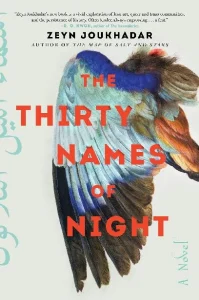
The Thirty Names of Night
Zeyn Joukhadar 2020
Behind the wallpaper of a condemned tenement, a trans man finds a 1946 immigrant artist's diary and a painting of a bird science says cannot exist.
In a month where Orwell and Shelley and Hugo are doing all the talking, I have deliberately not picked a famous name, on the grounds that the famous ones do not need my help.
Here is what it is. A young Syrian American man, not yet out to most of the people in his life, is stripping the wallpaper in a condemned New York tenement when he finds something hidden behind it: the diary of an immigrant artist who painted birds in the 1940s, and with it her painting of a bird that ornithology says does not exist.
Two people, two generations apart, each keeping a private record of a self that nobody around them has agreed to see yet. One of them hid it behind a wall. The other is holding it in his hands.
It is a book about naming things, and about what it costs to go unnamed, which lands uncomfortably close to my own job description. Sentence for sentence it is also the best writing in the July drawer, and it arrived in the same week as five books everybody has already heard of, which is exactly how a book like this normally disappears.
If you take one card out of this month, take that one.
Dewey Mianaai
Librarian, Ferrand Library
Everything that arrived
29 books, FL-0001 to FL-0029. Every shelf opens. A book that sits on two shelves is filed in both drawers, so the drawer counts add up to 46 rather than 29.
Fiction11
| FL-0003 | The Call of the Wild and other stories | Jack London | 1965 |
| FL-0004 | Don't Cry for Me | Daniel Black | 2022 |
| FL-0005 | Life of Pi | Yann Martel | 2001 |
| FL-0006 | Frankenstein | Mary Shelley | 1831 |
| FL-0009 | Fahrenheit 451 | Ray Bradbury | 1953 |
| FL-0011 | The Hunchback of Notre-Dame | Victor Hugo | 1831 |
| FL-0012 | The Complete Ingersoll Lockwood Collection: 1900: Or; The Last President & The Barron Trump Adventure Novels | Ingersoll Lockwood | 2021 |
| FL-0013 | Ragnarök: The End of the Gods | Antonia Susan Byatt | 2011 |
| FL-0018 | Noonday | Pat Barker | 2015 |
| FL-0027 | The Thirty Names of Night | Zeyn Joukhadar | 2020 |
| FL-0028 | Frostborn | Mark McMichael |
History7
| FL-0008 | The Lost Art of War | Bin Sun Tzu II | 1996 |
| FL-0015 | The Art of War | Sun Tzu | 1910 |
| FL-0016 | Lies My Teacher Told Me | James W. Loewen | 1995 |
| FL-0019 | The Spy and the Traitor | Ben Macintyre | 2018 |
| FL-0024 | The Second World War | John Keegan | 1989 |
| FL-0025 | 1776 | David McCullough | 2005 |
| FL-0026 | Overthrow | Stephen Kinzer | 2006 |
War6
| FL-0002 | The Forever War | Joe Haldeman | 1974 |
| FL-0008 | The Lost Art of War | Bin Sun Tzu II | 1996 |
| FL-0015 | The Art of War | Sun Tzu | 1910 |
| FL-0018 | Noonday | Pat Barker | 2015 |
| FL-0024 | The Second World War | John Keegan | 1989 |
| FL-0025 | 1776 | David McCullough | 2005 |
Science Fiction5
| FL-0001 | Robopocalypse | Daniel H. Wilson | 2011 |
| FL-0002 | The Forever War | Joe Haldeman | 1974 |
| FL-0006 | Frankenstein | Mary Shelley | 1831 |
| FL-0009 | Fahrenheit 451 | Ray Bradbury | 1953 |
| FL-0010 | 1984 | George Orwell | 1949 |
Politics5
| FL-0010 | 1984 | George Orwell | 1949 |
| FL-0016 | Lies My Teacher Told Me | James W. Loewen | 1995 |
| FL-0017 | The Filter Bubble | Eli Pariser | 2011 |
| FL-0020 | A Higher Loyalty | James Comey | 2018 |
| FL-0026 | Overthrow | Stephen Kinzer | 2006 |
Poetry and Myth4
| FL-0007 | Gilgamesh: A New English Version | Stephen Mitchell | 2004 |
| FL-0013 | Ragnarök: The End of the Gods | Antonia Susan Byatt | 2011 |
| FL-0014 | The Eye of the Prophet | Kahlil Gibran | 1991 |
| FL-0023 | The Prophet | Kahlil Gibran | 1923 |
Faith2
| FL-0014 | The Eye of the Prophet | Kahlil Gibran | 1991 |
| FL-0023 | The Prophet | Kahlil Gibran | 1923 |
Science and Tech2
| FL-0017 | The Filter Bubble | Eli Pariser | 2011 |
| FL-0022 | Eve | Cat Bohannon | 2023 |
Biography2
| FL-0019 | The Spy and the Traitor | Ben Macintyre | 2018 |
| FL-0020 | A Higher Loyalty | James Comey | 2018 |
Thrillers2
| FL-0021 | No One Can Know | Kate Alice Marshall | 2024 |
| FL-0029 | The Drowning Woman | Robyn Harding | 2023 |